
A moving window, not a new allowance
For any date you check, look at that date and the preceding 179 days. Count the days you spent in the Schengen area within those boundaries, then compare the total with 90. Tomorrow, the whole window shifts forward by one day. The earliest date drops out and the new date enters.
This is why a trip anniversary is a poor planning shortcut. Your first entry does not start a block that automatically closes with a fresh balance. Several separate visits can share the same window. A spring visit can still contribute to an autumn count even when you have spent months elsewhere between them.
Moving between countries inside the shared area does not create another day pool. Record the visit to the area as a whole. If two records cover the same calendar date, count that date once. Travel days matter too: both the entry date and the exit date belong in the total, including a visit that begins and ends on the same date.
Example: Ana’s spring visit and autumn stay
Example: Ana visited from 1 May to 20 May 2026, then returned on 15 September and is still there on 8 October 2026. The first stay uses 20 days. The second uses 24 days through the date being checked. Together, they use 44 days, leaving 46 in the current count.
The window on 8 October runs from 12 April to 8 October 2026. All of the May stay is still inside it. On 28 October, 1 May falls outside the window. On 29 October, 2 May follows it. The remaining May dates fall out in the same sequence, rather than disappearing together on one reset date.
If you continue staying after 8 October, each new day also enters the count. In this example the calculator gives a leave-by date of 13 December 2026 under that continuous-stay assumption. The returning May days help extend the count, but they do not mean every later stay has the same end date.
Read days coming back alongside planned stays
A day coming back means an older counted date has moved outside the window. It is useful to know the next such date, but a future visit can use that space as it opens. Look at the full sequence of visits rather than adding a returning block to today's balance and treating the result as permanent.
For a practical check, enter every relevant stay, choose your intended arrival date, and then inspect the count across the visit. A low total on arrival can rise during the trip. A different date or an extra weekend can change the result because both sides of the window are moving.
This guide describes ordinary short-stay counting. Days covered by a residence permit or long-stay visa have separate counting treatment. Keep those periods distinct from tourist stays when using the app, and use the source documents below for the rule that matches the period you are recording.
How Passport Days counts it
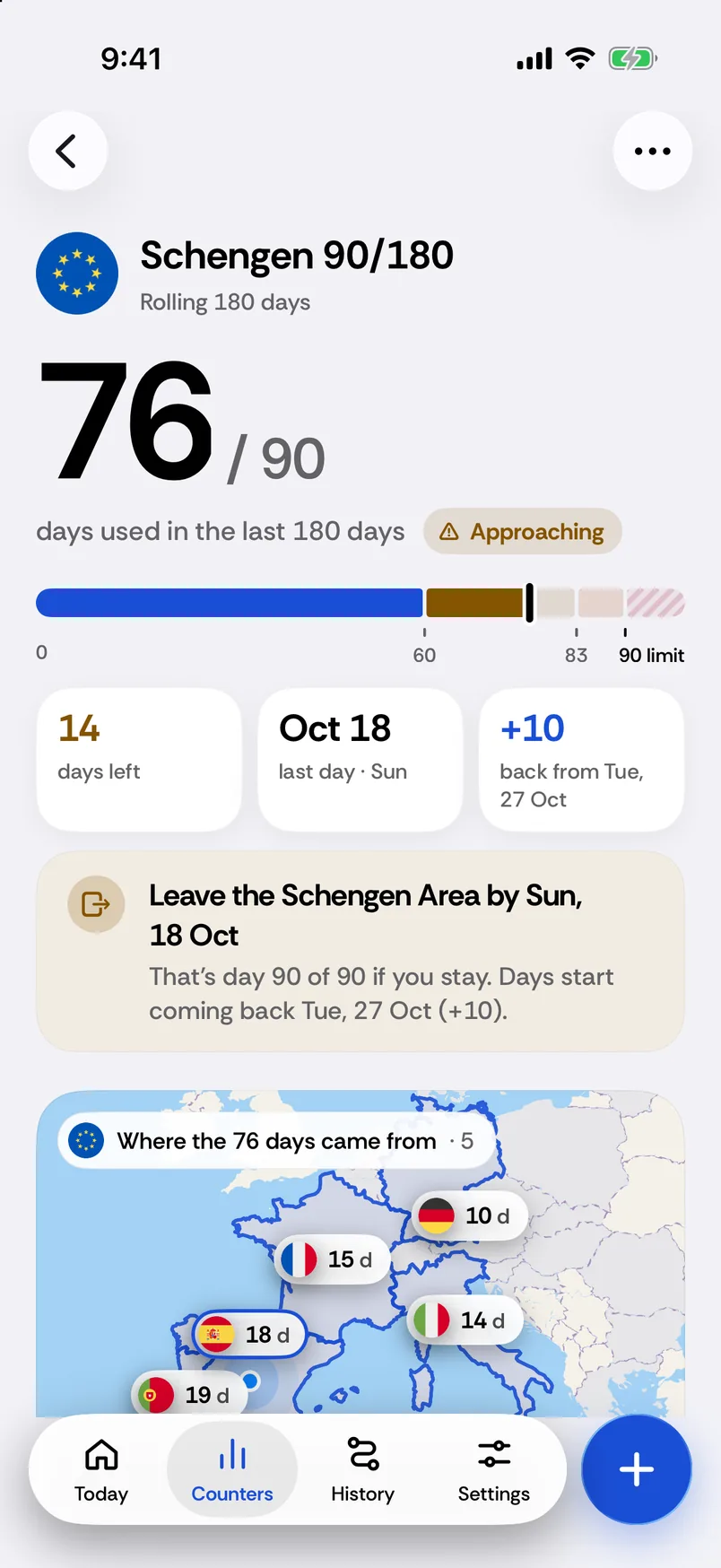
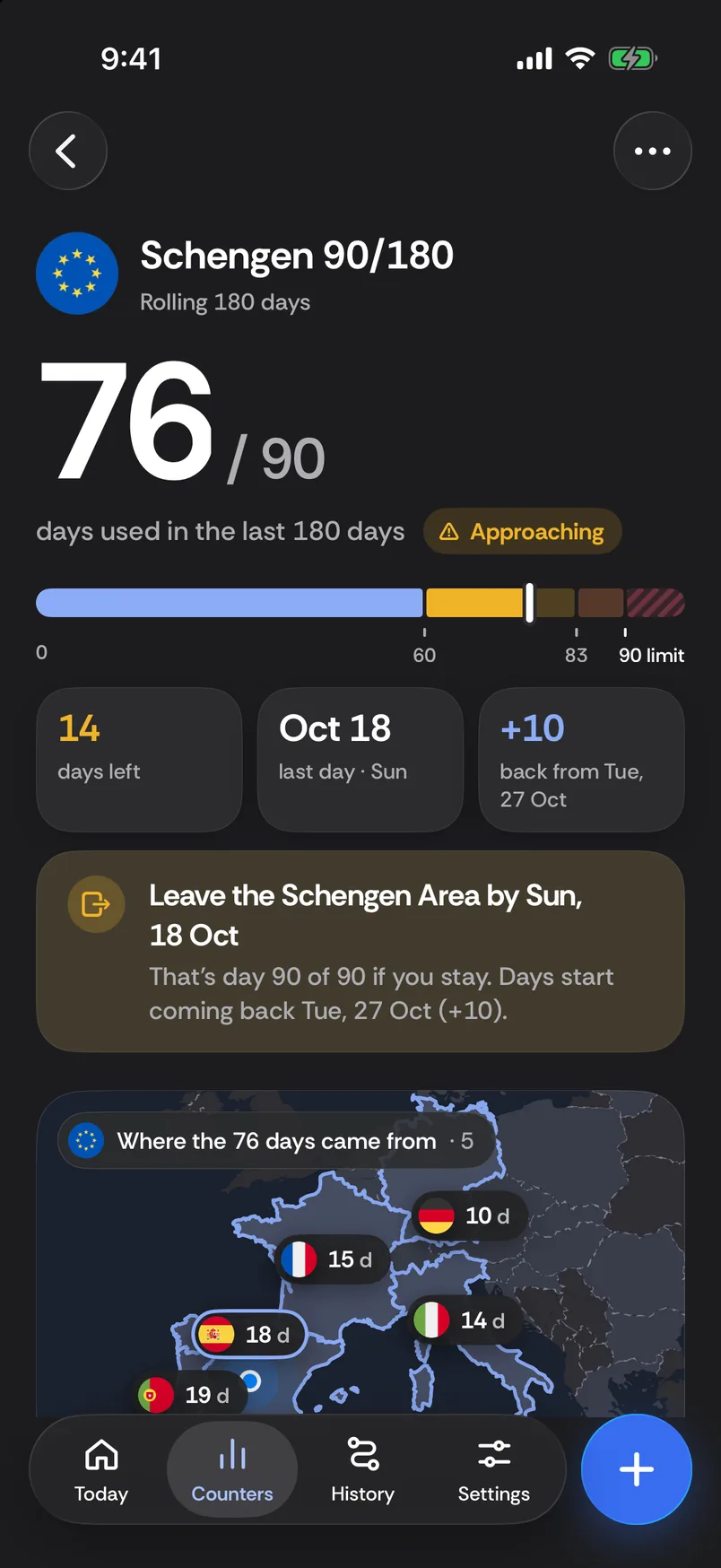
Passport Days puts your stay dates together, counts each date once and checks the rolling window for each day. The Schengen calculator shows days used, days left, a leave-by date assuming a continuous stay, and dates when older days return. Start with complete entry and exit dates; the calculator uses the same counting core tested against examples from the app's engine. A date marked Still there is counted through the date you check.
Let Passport Days do this
Keep the count on your iPhone, with your trips already there. Counters and automatic tracking are Premium.
Your next dates, together
See days left, when to leave and when older days come back, without rebuilding the count.
Record trips as you go
Automatic country tracking builds your history. Review it and correct any stay; your edit wins.
A reminder before the limit
Get a quiet heads-up when your allowance is running low.
Questions
Does leaving Schengen reset my 90 days?
No. Leaving stops you adding new Schengen days, but existing days remain in the rolling 180-day window until they fall outside it.
Do entry and exit days both count?
Yes. Both dates count. Entering and leaving on the same date uses one day, and overlapping records count each date once.
When does a counted day come back?
It leaves the count 180 days after that date. For example, 1 May 2026 drops out on 28 October 2026.
Can I plan with only my latest trip?
Bring in your earlier visits that touch the window too. A short latest trip can share its count with several older visits.